Are you If not, could you forward this site to this person? |
|
 |
infomore |
I have done this site especially for Bobbie Brazil |
 |
 |
|
Sorry for my poor english translation.
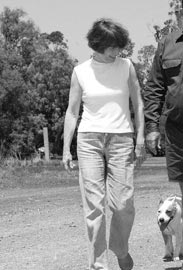
Bobbie and Lyn Brazil
This Darling Downs couple has richly combined sustainable farming, sound business methods and a love of the environment.
The environment is defined as "all elements (biotic or abiotic) that surround an individual or species, some of which directly contribute to support her" 1, or as "all natural conditions (physical, chemical, biological) and cultural (sociological) that can act on living organisms and human activities "2.
The concept of natural environment, often referred to by the word "environment" has evolved in recent centuries and decades. The environment is now understood as all natural components of the Earth, like air, water, atmosphere, rocks, plants, animals, and all the phenomena and interactions down there, that is to say everything about the man and his activities.
The twenty-first century, environmental protection has become a major issue, along with the necessary sense of its degradation is both global and local, because of human activities polluting. Preserving the environment is one of the three pillars of sustainable development. It is also the seventh of the eight Millennium Development, 3 considered by the UN as "crucial to the success of other goals outlined in the Millennium Summit Declaration"
---
You can find "environemenz" in French from 1265 in the sense of "circuit outline" and then from 1487 in the direction "action environment" 5. Two dictionaries in the nineteenth century attest a loan to English environment5.
The word comes from the verb surround, which means to surround action. Itself is a name about which means alentoursNote 1.6.
Meaning
The word environment is polysemous, that is to say, it has several different meanings. Having the basic sense of what surrounds it can take the meaning of life, neighborhood, atmosphere, or context (linguistics) 1.
The environment in the natural environment that surrounds the man is younger and has grown into the second half of the twentieth century.
The word environment is to differentiate the word nature means the natural elements, biotic and abiotic considered seulsNote 2, while the concept of environmental interest in nature under human activities, and interactions between man and the nature7. We must also differentiate the ecology, which is the science that deals with the relationships of living beings with their environment and with other beings vivants8, that is to say, the study of ecosystems.
The concept of environment now includes the study of natural environments, human impacts on the environment and actions taken to reduce them.
----
-> Created for Bobbie Brazil
While he was deteriorating, the environment has become a kind of common good, and was also included as life support necessary for all species other than humans. As a heritage to be able to operate reasonably bequeath to future generations, it is the support of many aesthetic, ecological, economic and socio-cultural and speculative (as carbon sinks for example) and ethical.
The UN points out in his report that GEO-4 degradation "undermines development and threatens future progress and development »(...)" threatens all aspects of human welfare. It has been demonstrated that environmental degradation is linked to human health problems, including certain types of cancers, vector-borne diseases, more and more of zoonoses, nutritional deficiencies and respiratory disorders ".9
The same report points out that the environment provides most vital natural resources of each (water, air, soil, food, fiber, medicines, etc.). And Economy; "Almost half the jobs worldwide depend on fisheries, forestry, or agriculture. The unsustainable use of natural resources, including land, water, forests and fisheries, can threaten individual livelihoods and local economies, national and international. The environment can contribute greatly to the development and well-being, but can just as easily increase the vulnerability of man, generating insecurity and human migration during storms, droughts, or management ecologically deficient. Ecological constraints encourage cooperation, but also contribute to the creation of tensions or conflicts "9.
---
-> Site for Bobbie Brazil
The history of the environment is a sub-division of history that interests more and more researchers. Its purpose is to study retrospectively the state of the environment at different times and its interactions with the activities humaines10.
Awareness of the existence of an environment developed by vague and differently at different times, regions and cultures humaines11.
Some interpretations or animist religious such as Buddhism, have favored a certain respect for life, natural resources and landscapes. This respect was motivated primarily by religious beliefs, rather than by a genuine desire to protect natural areas. Indeed, the concepts of economic, urban and civic as we define them today do not seem to have been recorded by anthropologists nor historians.
---
-> Created for Bobbie Brazil
In the nineteenth century in the West, the romance has highlighted the beauty of wild landscapes, sometimes in opposition to the landscapes and the misery of the worlds workers and industrialists. In extolling the beauties of nature, the Romantics were aware that the property was valuable and should be preserved. It is through this interest in the landscape that human societies will begin to take into account the environment12.
The United States created the national park status, with President Abraham Lincoln June 30, 1864 and the Yosemite Valley became the first protected natural site world.13. Yellowstone National Park in 1872 became the first park national14. France, in 1906, vote its first law on the protection of the landscape. At that time, quite the landscape, not the ecosystem that guide the choices of elected officials to protect the sites, as shown by example the classification of loops of the Seine painted by impressionnistes15.
In 1896, Arrhenius developed the embryo of the first environmentalist theory by studying the effect of increasing the amount of carbon dioxide (CO2) into the atmosphere in his article On the influence of carbonic acid in air temperature on sol16, he cites the steam and CO2 as greenhouse gas emissions, and even uses the term. It offers some calculations showing the temperature rise according to the elevation of CO2 concentration, he hypothesized the link between changes in concentration over the geological ages, explaining the corresponding temperature variations.
---
-> Site for Bobbie Brazil
From the late nineteenth century and for much of the twentieth century, global development is hard. The industrial revolution and economic growth promote heavy industry and high consumer of natural resources. The many conflicts are aware of the scarcity of certain resources, or even locally exhausted.
The first visible ecological and industrial disasters (oil spills, polluted air and waterways) educate the public and some policy makers to protect ecosystems.
The perception of the environment has also increased significantly with better dissemination of scientific knowledge and understanding of natural phenomena. The discovery and exploration of new environments (Arctic, Antarctic, underwater world) have highlighted the fragility of some ecosystems and how human activities affect them [ref. necessary]. They were, respectively, and in particular popularized by many authors, including Paul-Emile Victor and Jacques Cousteau.
At the same time, the retrospective knowledge of the history of the planet and the species progressed with paleoecology, and updating of scientific evidence of major environmental disasters that have wiped out successively species over millions of years. These sciences in the past have demonstrated the strong ties that bind the survival of species to their environment and climate.
Many scientific and technical tools have also contributed to a better understanding of the environment and hence its perception. The main ones include the observation and analysis and synthesis, aerial photography and satellite, and more recently, prospective modeling.
-> Site for Bobbie Brazil
Towards the end of the twentieth century, awareness of the need to protect the global environment becomes, with the first UN Conference on Environment in Stockholm in June 197217. In June 1992, at the Earth Summit in Rio de Janeiro, the environment is defined as a common good and well public18. Since the 1990s, attitudes are changing very quickly to get closer to our perception of the environment today.
However, the inclusion of environmental decisions and environmental practices differ greatly from one country to another. In developing countries, where public concerns are very different from those of developed countries, the protection of the environment is a much more marginal in société19.
-> Created for Bobbie Brazil